Capillary Placement
Find an open behavioral health bed and hold it
Capillary Placement is software for running a statewide bed registry. Deputies, crisis teams and emergency departments see the nearest open psychiatric and crisis beds by drive time and ask several facilities at once. The first facility to offer a bed holds it. The state sees how long each request waits for a bed.
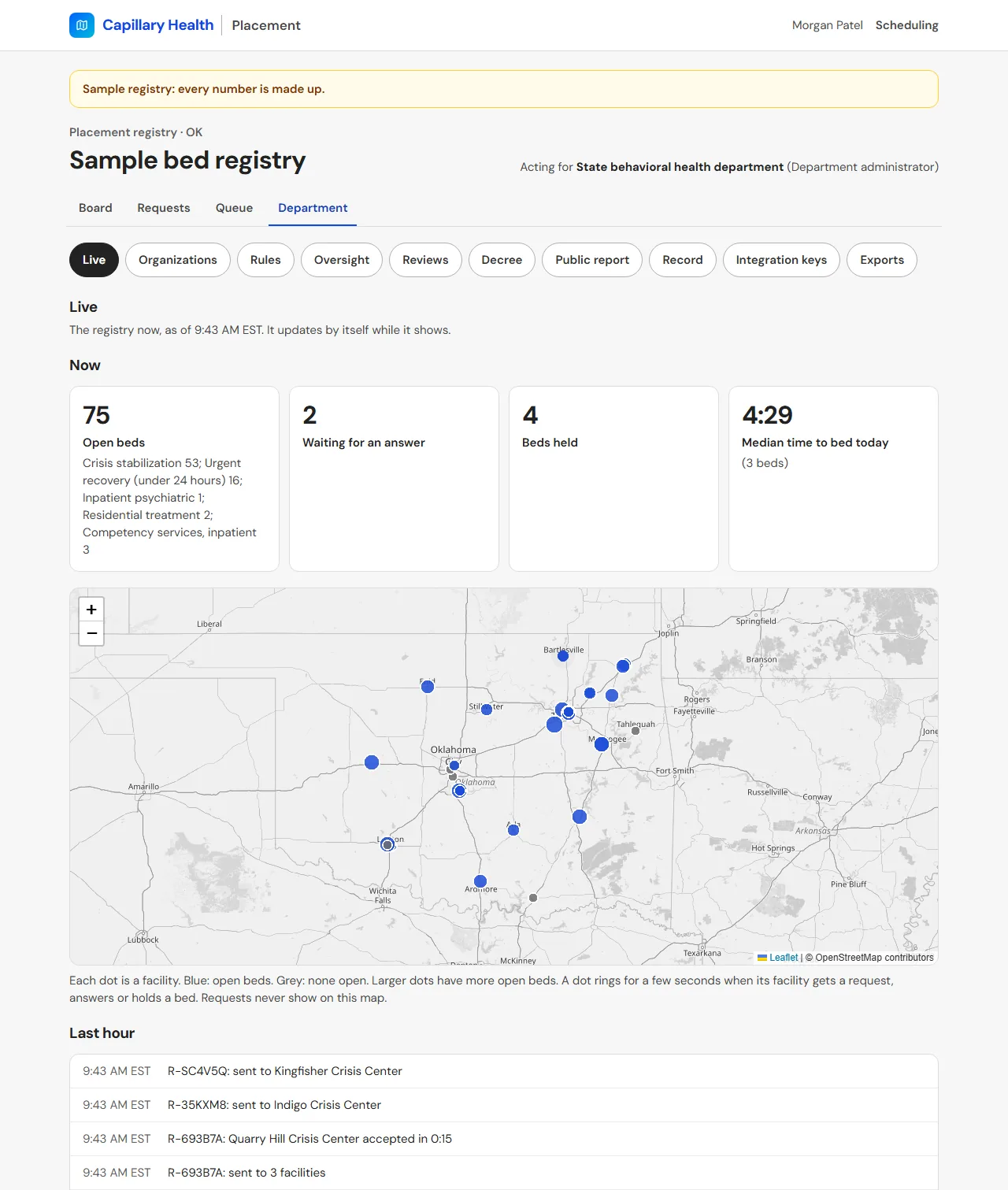
How it works
Each request moves through four steps. The pictures show a sample registry with made-up facilities and numbers.
1. Request
Ask for a bed from a phone
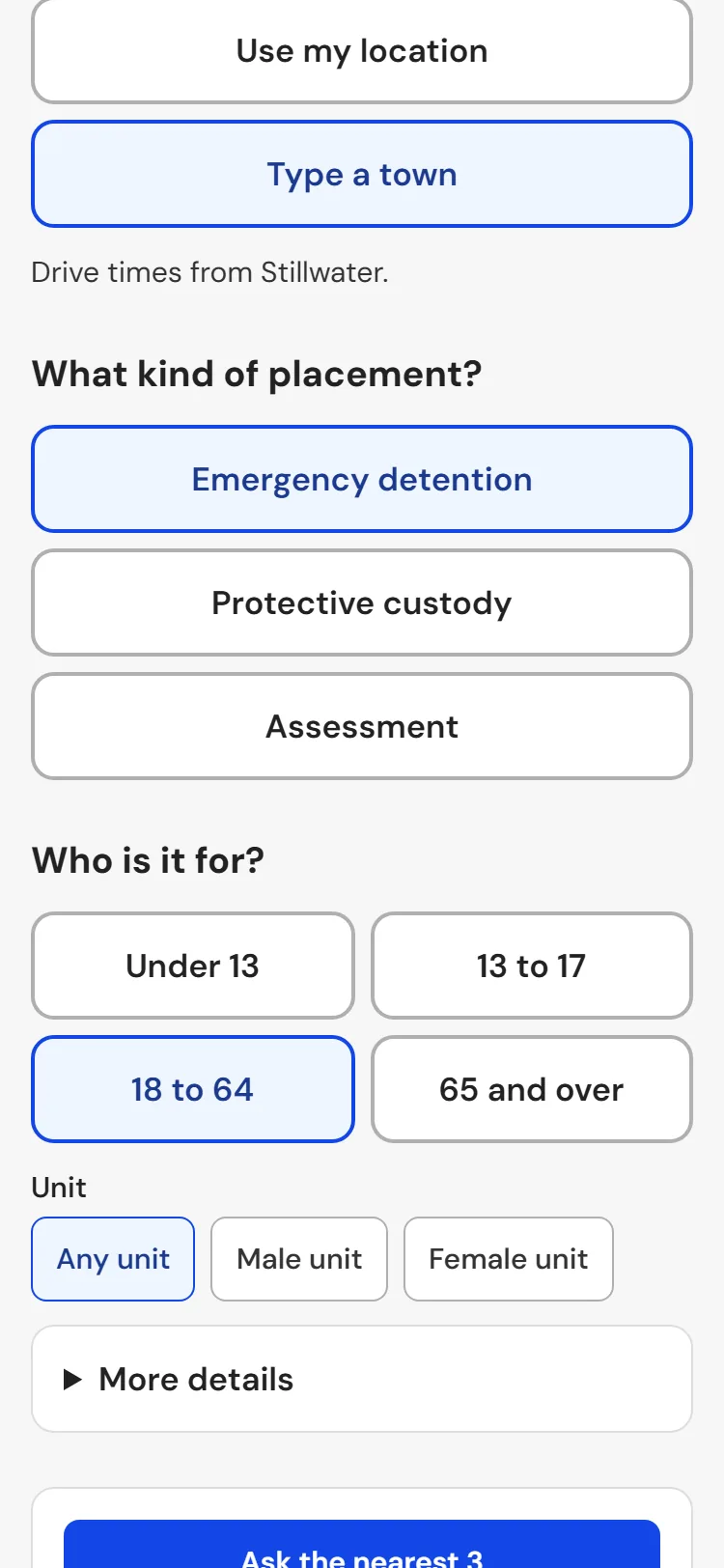
Choose the kind of placement and the age group. The nearest facilities with open beds appear by drive time from where you are, each with its 24-hour line. One button sends the request to several of them at once.
2. Offer
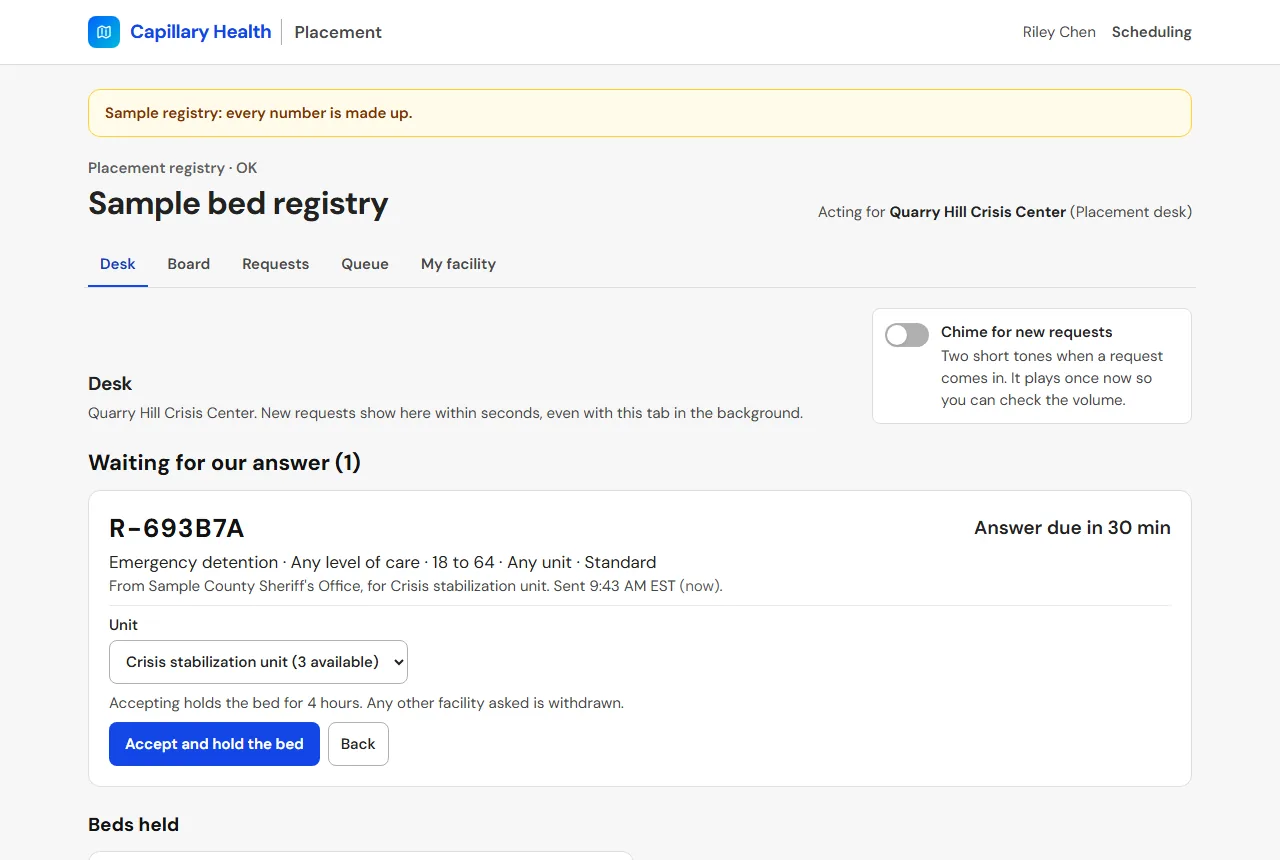
The facility offers a bed
The request appears on the facility's Desk screen with the time left to answer. To offer, intake staff choose a unit with an open bed.
3. Hold
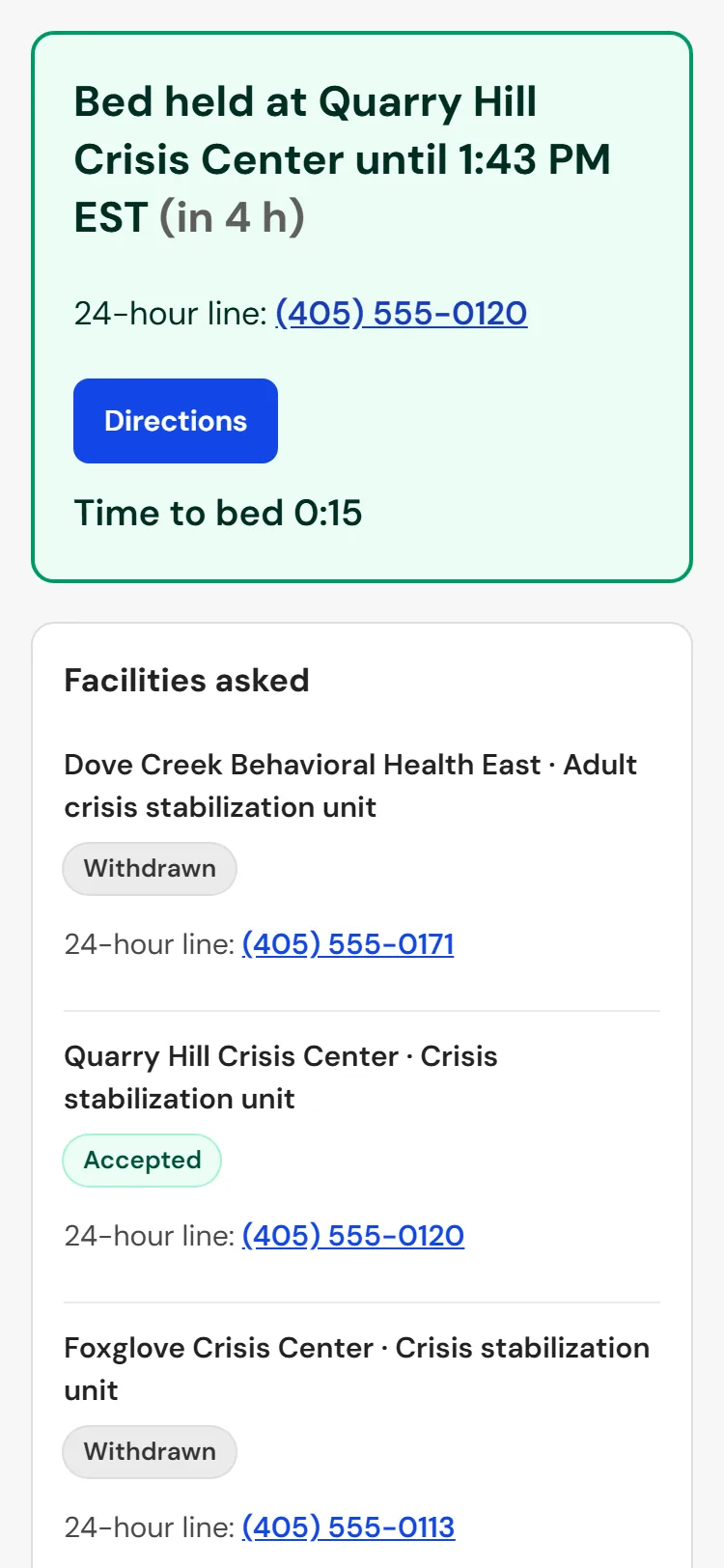
The first facility to offer holds the bed
The bed stays held for 4 hours, or for the time the state sets. You see where the bed is held and until when, with the facility's 24-hour line and directions. The request is withdrawn from every other facility, so none of them keeps a bed for someone who is not coming.
4. Arrive
The facility marks the arrival
Each step is time-stamped, so you, the facility and the state see the same record.
Who uses it
Deputies, crisis teams and emergency departments
Find an open bed, request it and follow the answer on a phone.
Intake staff at each facility
Answer requests, see which beds are held and keep open-bed counts current.
The state behavioral health agency
Watch open beds and requests, set the rules and publish a public report.
Useful before any facility signs up
Capillary Placement starts from public data. Facility names and 24-hour lines come from the state's own lists, and drive times come from road data. On the first day, a deputy can find and call the nearest crisis centers. Open-bed counts appear as facilities join.
No names or diagnoses
A request lists only the kind of placement, the level of care, the age group and how urgent it is. There is no field for a name, a birth date or a diagnosis.
The state sets the rules
- How long a facility has to answer a request.
- How long a bed stays held.
- When a bed count is out of date.
- How many facilities one request can go to.
Every request, answer and held bed goes into a record that an auditor can check. The public report shows totals only.
Bed registries by state
In a 2025 national survey, 25 of the 50 state mental health agencies that answered said they run a crisis bed registry.
- AlabamaNo registry found
- AlaskaNo registry found
- ArizonaState runs a registry
- ArkansasNo registry found
- CaliforniaRegistry planned
- ColoradoRegistry required by law
- ConnecticutState runs a registry
- DelawareState runs a registry
- District of ColumbiaNo registry found
- FloridaNo registry found
- GeorgiaState runs a registry
- HawaiiState runs a registry
- IdahoState runs a registry
- IllinoisRegistry required by law
- IndianaNo registry found
- IowaRegistry required by law
- KansasState runs a registry
- KentuckyNo registry found
- LouisianaNo registry found
- MaineNo registry found
- MarylandRegistry required by law
- MassachusettsRegistry required by law
- MichiganRegistry required by law
- MinnesotaState runs a registry
- MississippiState runs a registry
- MissouriState runs a registry
- MontanaNo registry found
- NebraskaState runs a registry
- NevadaState runs a registry
- New HampshireState runs a registry
- New JerseyRegistry required by law
- New MexicoNo registry found
- New YorkNo registry found
- North CarolinaState runs a registry
- North DakotaRegistry required by law
- OhioState runs a registry
- OklahomaRegistry required by law
- OregonRegistry required by law
- PennsylvaniaNo registry found
- Rhode IslandState runs a registry
- South CarolinaNo registry found
- South DakotaNo registry found
- TennesseeState runs a registry
- TexasNo registry found
- UtahNo registry found
- VermontState runs a registry
- VirginiaRegistry required by law
- WashingtonRegistry planned
- West VirginiaNo registry found
- WisconsinRegistry required by law
- WyomingNo registry found
Common questions
- What is a behavioral health bed registry?
- A bed registry is a shared, current list of open psychiatric, crisis and substance use beds. The people placing someone can see where a bed is open instead of calling facility after facility.
- Does Capillary Placement keep names or diagnoses?
- No. A request lists only the kind of placement, the level of care, the age group and how urgent it is. Nobody enters a name, a birth date or a diagnosis.
- Is this a state's official registry?
- No. Capillary Placement is software a state can run its registry on, under the state's own name. Each state's page links to the state's behavioral health agency.
- What does it run on?
- It runs in a web browser on a phone or a desktop computer, with nothing to install. Alerts go by email.
- How can I see it?
- Request a demo. We show it on a sample registry.
Sources
See it on a sample registry
We also show the public data your state's registry would start from.