Capillary Placement
Does Oregon have a behavioral health bed registry?
This page is from Capillary Health, not from the state government.
Oregon law requires a registry of open behavioral health beds. The state's mental health agency said in 2025 that it does not run a crisis bed registry. With Capillary Placement, deputies, crisis teams and emergency departments in Oregon would see the nearest open beds by drive time and ask several facilities at once. The first facility to offer a bed would hold it.
Oregon today
Oregon law requires providers of intensive behavioral health treatment for children and adolescents to report bed capacity to the Oregon Health Authority. Separately, a state-funded coordination center tracks behavioral health and substance use bed census across Oregon for the people who place patients.
- Registry
- Oregon Behavioral Health Coordination Center
- Law
- ORS 430.717
- State agency
- Oregon Health Authority
Checked November 2026.
How Capillary Placement would work in Oregon
Each request moves through four steps. The pictures show a sample registry with made-up facilities and numbers.
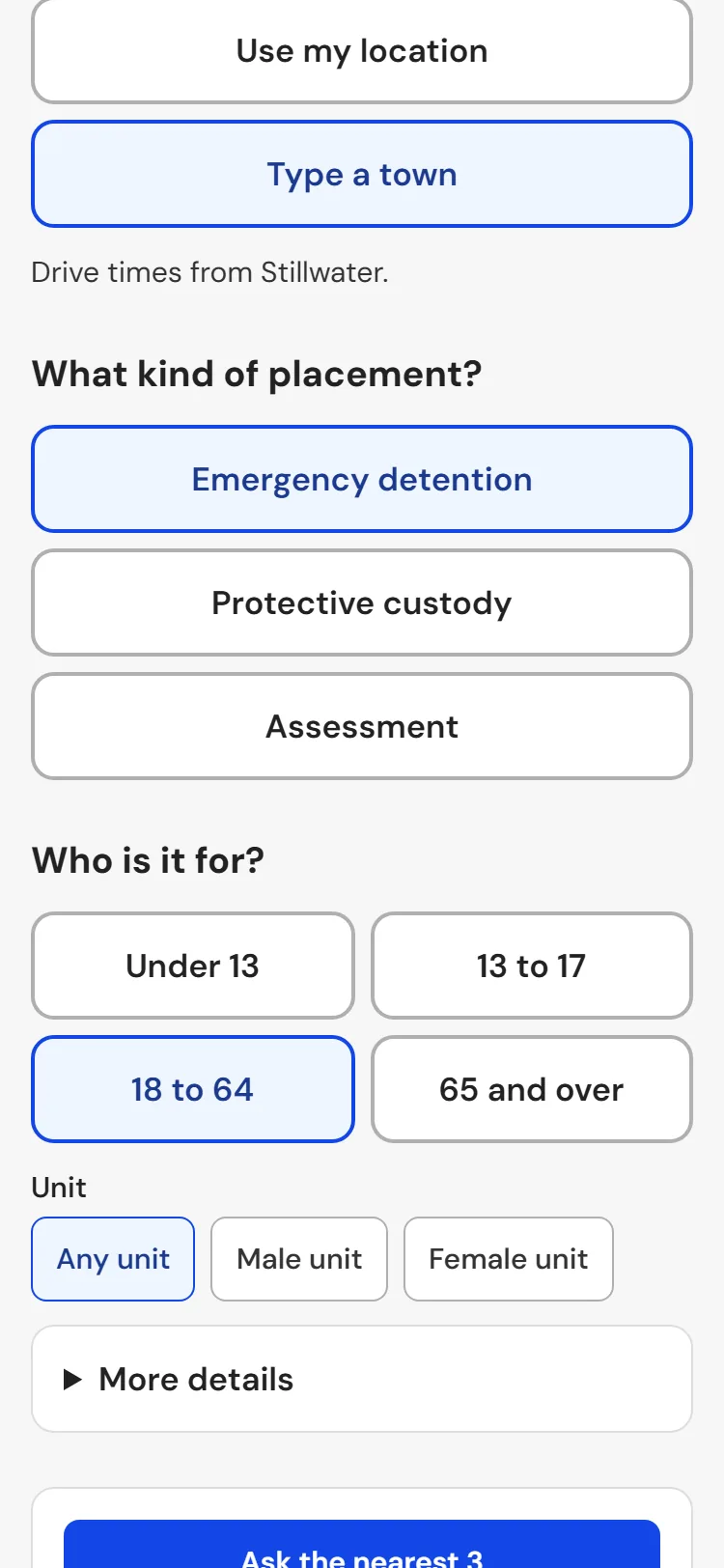
1. Request
Ask for a bed from a phone
Choose the kind of placement and the age group. The nearest facilities with open beds appear by drive time from where you are, each with its 24-hour line. One button sends the request to several of them at once.
2. Offer
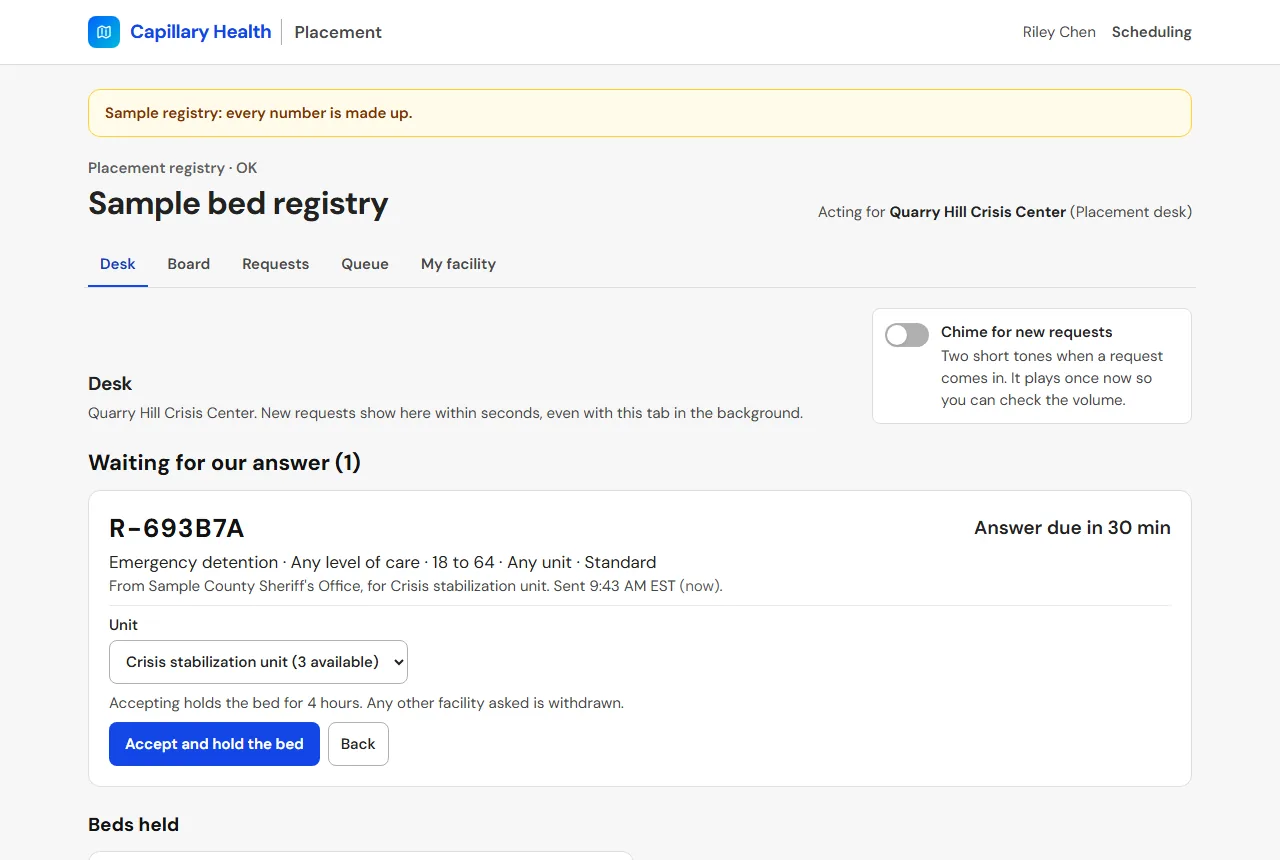
The facility offers a bed
The request appears on the facility's Desk screen with the time left to answer. To offer, intake staff choose a unit with an open bed.
3. Hold
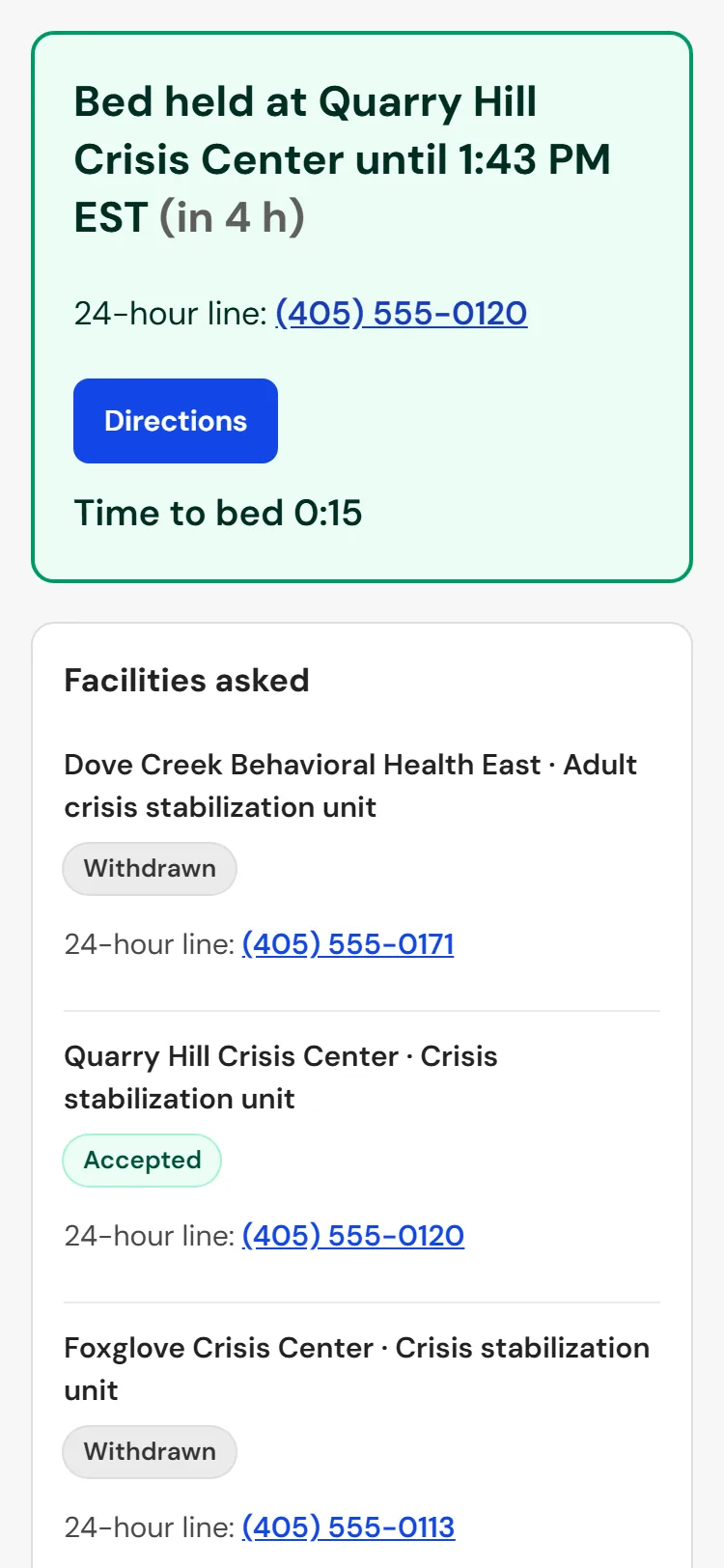
The first facility to offer holds the bed
The bed stays held for 4 hours, or for the time the state sets. You see where the bed is held and until when, with the facility's 24-hour line and directions. The request is withdrawn from every other facility, so none of them keeps a bed for someone who is not coming.
4. Arrive
The facility marks the arrival
Each step is time-stamped, so you, the facility and the state see the same record.
What the state sees
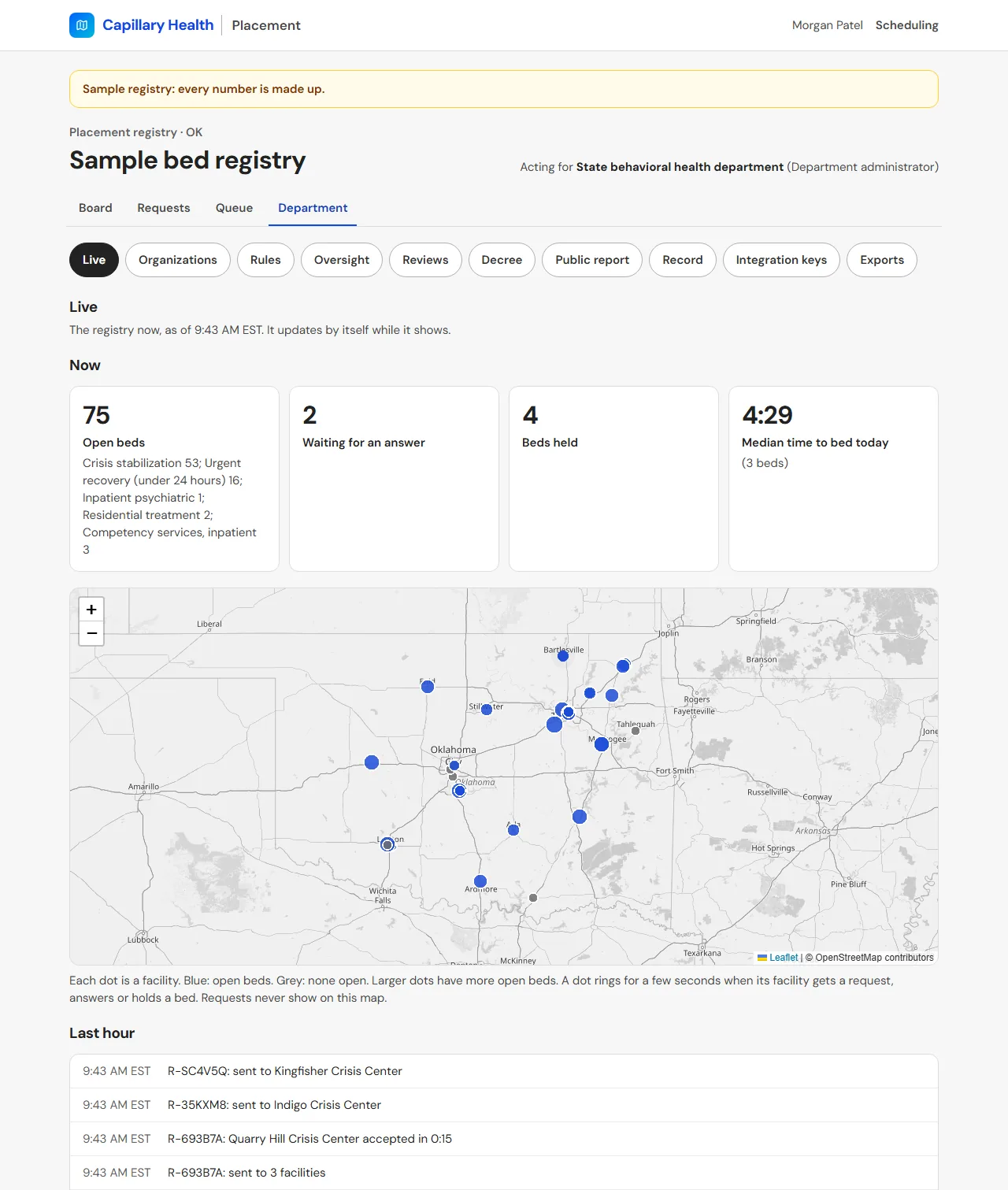
The state's Live screen shows open beds by level of care, requests waiting for an answer, beds held and today's median time to bed. It updates on its own. Its map shows facilities, never a request or a person.
Day one in Oregon
Before any facility signs up, a registry in Oregon would start from public data: the 12 inpatient psychiatric facilities in CMS's file, the state's own lists of crisis, residential and substance use facilities, and drive times from road data. On the first day, a deputy could find and call the nearest crisis centers. Open-bed counts would appear as facilities join.
No names or diagnoses
A request lists only the kind of placement, the level of care, the age group and how urgent it is. There is no field for a name, a birth date or a diagnosis.
The state sets the rules
- How long a facility has to answer a request.
- How long a bed stays held.
- When a bed count is out of date.
- How many facilities one request can go to.
Common questions
- How many inpatient psychiatric facilities are in Oregon?
- CMS lists 12 inpatient psychiatric facilities in Oregon: 2 psychiatric hospitals and 10 psychiatric units in general hospitals.
- Is this page from the state government?
- No. This page is from Capillary Health, not from the state government.
Sources
- Oregon Revised Statutes 430.717oregonlegislature.gov
- Oregon Behavioral Health Coordination Center flyeroregon.gov
- NASMHPD Research Institute (NRI), Behavioral Health Crisis Service and Bed Registries, 2025, published January 2026nri-inc.org
- CMS, Inpatient Psychiatric Facility Quality Measure Data, by Facility, published August 13, 2026data.cms.gov
Talk to us about Oregon
We show Capillary Placement on a sample registry, and the public data a registry in Oregon would start from.